THE THUNDER BAY POLICE PIPE BAND
Forty Years of Service, Tradition, and Community
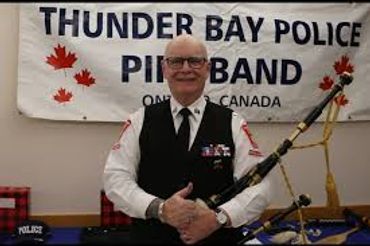
The Thunder Bay Police Pipe Band was my vision - seizing the opportunity in creating an volunteer organization that recognized and responded to the need to serve as both a musical ambassador for the Thunder Bay Police Service and a bridge between the police and the community is a dream come true. Founded in September 1984, the band began a journey that would grow into more than four decades of volunteer service, musical excellence, and community engagement.
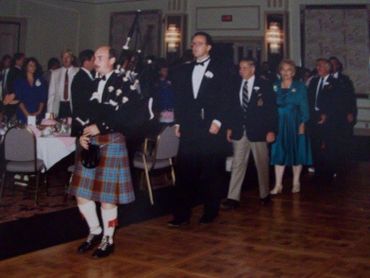
After a year of instruction and rehearsals, the band's first public performance took place in November of 1985 at the Thunder Bay Police Association Dinner and Dance, marking the beginning of a proud tradition of representing the Thunder Bay Police Service at ceremonies, community events, charitable functions, and commemorations throughout Northwestern Ontario and beyond.
In 2024, the Thunder Bay Police Pipe Band proudly reached 40 years of service. This remarkable milestone was celebrated in 2025, coinciding with the anniversary of the band's first public performance—a fitting tribute to the volunteers, musicians, supporters, and community partners who have carried the band's legacy forward since its creation.
A Vision Becomes Reality
From the beginning I understood and communicated that building a successful pipe band required a strong foundation of musical leadership, discipline, and commitment. I was supported in bringing together talented musicians and dedicated learners who shared his vision of creating an organization defined by excellence and service.
Among those early contributors was Staff Sergeant Terry Walls, an accomplished drummer who had worked as a professional session musician in Las Vegas and with the Hamilton Fire Service, before joining the Thunder Bay Police Service. Terry brought an incredible intensity with his wealth of musical experience, professionalism, and performance knowledge to the band, helping establish the high standards that would define the percussion section. Never to be satisfied with his own talents, Terry recruited Murray Brown, an accomplished pipe band snare drummer, who would later join the Thunder Bay Police.
I also also recruited Sergeant Peter Toohey to develop and instruct the bass and tenor drum corps. Together, these early leaders helped create the strong musical foundation that allowed the band to grow and achieve success at community, provincial, national, and international levels.
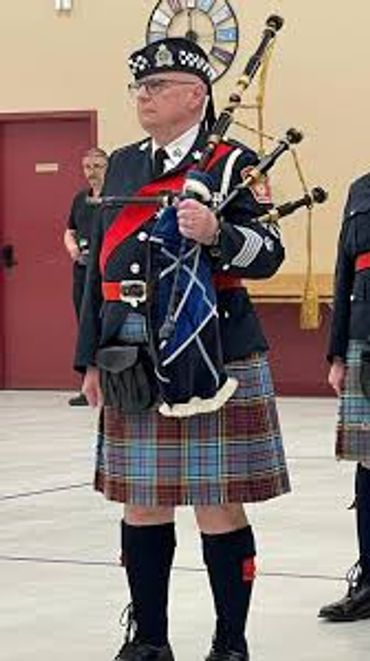
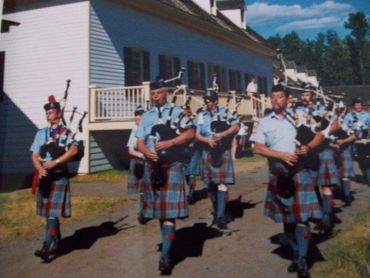
From the outset, the band adopted the Anderson Tartan as its official tartan. This choice honoured the family connection of the band's first Colonel-in-Chief, Chief of Police Gerry Ouellette. Chief Ouellette's wife, was Debbie Anderson, making this choice a meaningful symbol of the band's heritage, its founding leadership, and its close relationship with the Thunder Bay Police Service.
A Volunteer Organization Built on Service
Although the band was created under the banner of the Thunder Bay Police Service, it has always been a true community organization. Membership has never been limited to police officers. Instead, the band has welcomed volunteers from all backgrounds who share a passion for music, tradition, and service.
Joining the band required demonstration of willingness and commitment to serve. At its heart the Thunder Bay Police Pipe Band remains a duty band. It forms part of the organizational chart of the Thunder Bay Police Service.
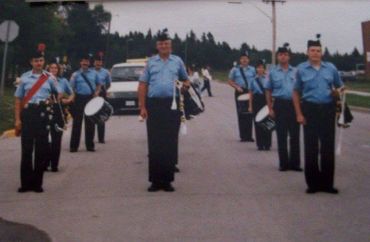
Joining a police band is a bit different than other pipe bands. In addition to demonstrating commitment to attending practices, rehearsals and performances, with a good sounding instrument with the capacity to perform the required tunes, each member must maintain a level of discipline that recognizes the individual represents the larger organization in how they carry themselves as member. With the authorization of the Thunder Bay Police Services Board, every member proudly wears the Thunder Bay Police Pipe Band uniform as a goodwill ambassador. They represent not only the police service but also the values of dedication, respect, and community partnership.
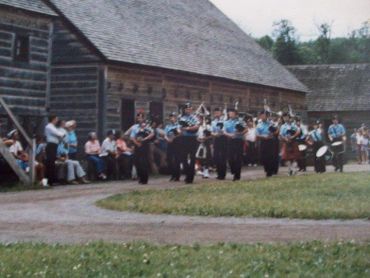
For more than forty years, members have freely donated thousands of hours of their time. The band maintains a demanding schedule, with more than forty rehearsals annually preparing for up to thirty-five full-band performances each year. Individual members also contribute numerous additional solo performances at community events, care facilities, ceremonies, and various celebrations.
The commitment of these volunteers has made the Thunder Bay Police Pipe Band one of Northwestern Ontario's most respected cultural and ceremonial organizations.
Serving the Community Through Music
Throughout its history, the Thunder Bay Police Pipe Band has performed thousands of engagements across Thunder Bay, Northwestern Ontario, Canada, the United States, and internationally, including a notable tour of Scotland in 1992, which was a Canada 125 project.
The band has also ensured that important local ceremonies receive proper recognition and dignity, including supporting memorial services for fallen police officers and honouring those unable to attend larger provincial or national commemorations.
Supporting Veterans and Preserving Heritage
Supporting veterans and preserving Canada's military heritage have always been central to the band's mission.
The band has regularly performed at veterans' events, Remembrance Day ceremonies, and military commemorations, helping ensure that the sacrifices of those who served are never forgotten. Through music and ceremony, members have helped connect generations by honouring the past while educating future generations.
The band has also worked closely with youth organizations, cadet programs, and community groups, demonstrating the importance of service, remembrance, and civic responsibility.
Community Events and Charitable Support
Beyond formal ceremonies, the Thunder Bay Police Pipe Band has consistently used music as a way to bring people together.
The band has organized and participated in community events such as “Thunder Bay Police Pipe Band and Friends,” celebrating Celtic culture while supporting charitable causes and commemorating important historical milestones.
Members have performed free concerts in parks, churches, seniors' residences, and long-term care facilities, ensuring that music and community connection reach those who may not otherwise have access to live performances.
Over the years, the band has supported dozens of charitable organizations and has always donated its time and talent without charge allowing them to focus their resources where they are needed most.
Musical Excellence and Tradition
Musical excellence has been a defining characteristic of the Thunder Bay Police Pipe Band. Members have competed at local, regional, national, and international competitions, earning recognition while continually striving to improve.
The band's motto, “Ad Posse ad Esse” — From Possibility to Actuality, reflects its journey from a vision in 1984 to a respected institution serving the community for more than forty years.
This motto also became the title of one of the band's musical recordings, symbolizing the transformation of an idea into achievement.
Members of the band have also composed original music presented to Canada's Monarch, dignitaries, and notable citizens, reflecting the band's artistic contribution and commitment to honouring important occasions.
Recognition of Volunteer Service
The dedication of Thunder Bay Police Pipe Band members has been recognized at the national level through the Sovereign's Medal for Volunteers, which honours Canadians who have made significant, sustained, and unpaid contributions to their communities.
Twelve band members have received this prestigious recognition for their extraordinary commitment to volunteer service.
These honours represent more than individual accomplishments. They reflect the culture of service that has defined the Thunder Bay Police Pipe Band since its creation—a culture built on generosity, teamwork, and a belief that community is strengthened when people give of themselves.
A Legacy of Goodwill in Action
The Thunder Bay Police Pipe Band embodies the enduring principle of community policing expressed by Sir Robert Peel:
“The police are the public and the public are the police.”
For more than forty years, the band's members have demonstrated that relationship through music, ceremony, compassion, and service.
From its beginnings in 1984, the Thunder Bay Police Pipe Band has grown into a cherished cultural ambassador for Thunder Bay and Northwestern Ontario. Its legacy is measured not only by the thousands of performances it has delivered, but by the friendships it has built, the veterans it has honoured, the charities it has supported, and the communities it has brought together.
The sound of the pipes and drums continues to represent pride, remembrance, tradition, and service—ensuring that the vision created more than forty years ago continues to inspire future generations.
While I had the vision and brought it to life, this hasn't happened in a vacuum. The dedication of our Colonels-in-Chief, our band executive, leading drummers, pipe sergeants, the members themselves, and of course the three other pipe majors that supported this enterprise while I was seconded away to various duties ensured that the band flourished. I'm eternally and especially grateful for the work of
and
Pipe Major Errol Schell.
Before the Thunder Bay Police Pipe Band...
... and everywhere I've gone, I've wanted to support the local pipe band...
I started learning the bagpipes when I was 11 years old and, quite honestly, I'm still learning.
I have been fortunate to play with a number of outstanding pipe bands throughout my career. I began with the St. Catharines Pipe Band (Bruce Tartan) where my first instructor was Pipe Major Keith Dewar. From there, I joined the Chippewa Legion Pipe Band (Caledonia Tartan) under Pipe Major George Davidson and studied under the watchful eye of Pipe Major Jimmy Greig, who had previously served as Pipe Major of the Clan McFarlane Pipe Band before Ken Eller assumed that role. With Chippewa, we earned North American Champion Supreme titles in both Grade 4 and Grade 3. The band eventually evolved into the Niagara and District Pipe Band under George Davidson, then under Pipe Major Jake Watson, where we captured another North American Champion Supreme title.
I was tired of competitive piping - it was hard and disciplined work. Each day required one hour of personal chanter practice then one hour of pipe practice. Then there was chanter/ pipe practice once a week as a band, then taking a personal lesson once a week, teaching a lesson once a week, and then a full day with the band on Sunday. For a time, the pipes and I took a bit of a break from each other. I was recruited a short time later to join the Niagara Regional Police Pipe Band (Earl of St Andrews tartan) - they had been together about three years at that time, and I came on to assist with teaching and maintenance - I ended up serving as Pipe Sergeant under Pipe Major Jim Caddis. The band changed course from being a duty/ parade band and re-entered the contest circle when I moved west to Winnipeg. While there I spent a short time playing with the Winnipeg Police Pipe Band (Royal Stewart tartan).
In 1983, I accepted a position as a police officer in Thunder Bay. Before founding the Thunder Bay Police Pipe Band in 1984, I played briefly with the MacGillivray Pipe Band of Thunder Bay (MacGillivray tartan) under Pipe Major John Ferguson.
While posted to Ottawa, in 2007 I joined the Highland Mist Pipe Band (Caledonia tartan). As a member of the band's leadership team, I instructed players, maintained instruments, and was responsible for tone and tuning. It was a privilege to help guide the band to a North American Champion Supreme title in Grade 5. Holding titles as a band member in grades, 5, 4, 3, and 2, I can honestly say I've done my homework in an idiom I love so much.
I've written an instructional book and number of pipe tunes and have been fortunate in this endeavour. One of my tunes was presented to Her Royal Highness Queen Elizabeth II on the occasion of her 50th Jubilee. I was also requested to perform the tune for Lieutenant Governor of Ontario James Bartleman on us visit to Thunder Bay.
During the same period that I was supporting Highland Mist, I also joined the Royal Canadian Mounted Police National Capital Region Pipes, Drums and Dancers, (RCMP tartan) first wearing the Red Serge in 2007 under Pipe Major Graeme Ogilvie and now under Pipe Major Iain Tait.
The RCMP has provided me, both professionally and musically, with innumerable opportunities. The National Capital Region Pipes, Drums and Dancers is the RCMP's duty band for Ontario, one of eight equally dedicated RCMP pipe band units across Canada. Together, these bands represent the Force through a distinctive blend of musical excellence, precision drill, and ceremonial tradition. Few sights are more inspiring than a line of scarlet-clad pipers and drummers representing Canada with pride and professionalism.
Through the RCMP, I have had the privilege of performing at three Royal Edinburgh Military Tattoos (2015, 2019, and 2024), the Belfast Tattoo, at Vimy Ridge, Hill 70, the Royal Nova Scotia International Tattoo, the New Hampshire Highland Games, the Estes Park Highland Games, and as duty band at the Glengarry Highland Games, and events in Quebec City. Volunteering with the RCMP has taken me across Canada, to Scotland, Ireland, The Netherlands, Belgium, France, Germany, and Sweden, despite living more than 1,400 kilometres from Ottawa.
The distance has never been a concern. Instead, it has given me the opportunity to once again become a follower—to continue learning from exceptional leaders. I have often said to two of the finest gentlemen I know, Graeme Ogilvie and Iain Tait, "Just tell me where to stand and tell me what to play."
In Thunder Bay, I continue to play with the Pipes and Drums of the Lake Superior Scottish Regiment, where Warrant Officer Bill Peters serves as Pipe Major.
Every one of these experiences has shaped me as a piper, a leader, and a teacher. They have continually challenged me to pursue excellence while reminding me that there is always more to learn about organizations, the people in them and their motivation, the music, and the intersectionality of these elements. The knowledge, standards, traditions, and inspiration I have gained from these remarkable bands and leaders have found their way into the Thunder Bay Police Pipe Band. If our band has enjoyed any measure of success over the past four decades, it is because I have been fortunate enough to stand on the shoulders of those who came before me, use lessons learned, and create an environment where people want to give their best.
As with all lessons I've learned, leadership begins by first being willing to follow, to listen and to learn, and it all starts by just showing up.
THE THUNDER BAY POLICE PIPE BAND
35th ANNIVERSARY SPEECH
In September of 1984 fifteen police officers, many of whom had never played pipes or drums and some with absolutely no previous musical experience gathered at the old RCMP building on Waterloo Street to follow the dream of creating a pipe band. With a bank balance of less than one hundred and fifty dollars made up from donations of the members, the band set off on a course to build a band to provide yeoman duties to the Thunder Bay Police Service.
Carved out through dedication and hard work over these last 35 years, the band is well entrenched in Northwestern Ontario and has served the Thunder Bay Police Service under seven chiefs of police, and a membership list of nearly two hundred names that ebbed and flowed through the organization. These pipers and drummers have dedicated themselves to the task of serving this community and on the contest field. Many members moved on to other bands, and we have attracted members to this band from some high level organizations. While this is certainly noteworthy, the real work is done right here, in our back yard.
If I can boast for a moment, I’d like to say that our efforts have not gone unnoticed. The last several years have been punctuated by some real highs. Many of our members of the band have been recognized for their service having been decorated no fewer than sixteen times by the Governor General of Canada. Members have received the Canada 125 Medal, The Queens Golden and Diamond Jubilee medals, and a dozen presentations of the Sovereigns Medal for Volunteers. Of that last group, those twelve people volunteered in exceed of 90,000 hours. We are awfully proud of these accomplishments.
It has not been without its heart aches. Today we fondly remember several members who are no longer with us. And we are honoured to have members of their families with us today.
We remember
Piper Dave Coffee - founding member
Piper Margaret Olsen
Piper Marv Crocker - a founding member
Pipe Major Bonnie Turner
Drum Sergeant and Honorary Band Chieftain Peter Toohey - a founding member
Pipe Major Emeritus Ken Wilson
Drum Sergeant Murray Brown
Lads and lassies, you are gone, but you are not forgotten.
While we fondly remember them, their memory lives on in the bonds and stories of our music and our pipe band family.
Speaking of family, we acknowledge the support provided by our families - if only at home when we are learning new tunes, or time away from them when we are attending another event in support of the community.
As we strive towards the next decades of service, we are pleased to be graced by the presence of some very talented young people who are the future of our pipe band family. They too share the devotion and dedication to the duty of service to our community. There are many fresh faces in our band and we are glad to have them and the support of their parents, grandparents, step parents and caregivers. You are part of this extended family too.
We are part of a niche of a pipe band community and we are blessed to have members of the Pipes and Drums of Thunder Bay, the Macgillivray Pipe Band of Thunder Bay and the Pipes and Drums of the Lake Superior Scottish Regiment here with us. The Morgan School of Highland Dancing is with us as well. We are honoured to be part of this fraternity with you.
There are some people here that we would like to recognize.
For our 35th year we have produced a challenge coin, limited to 100 pieces. The coin represents that you are a member of the band, or by extension, a supporter of this enterprise. Many have already been presented on previous occasions. Today we would like to acknowledge the following people;
Pat Administrator of the Moose Hall
Cliff Niles - Pipe Major of the Macgillivray Pipe Band
Heather Morgan
Inspector Ryan Gibson - Commanding Officer of the Thunder Bay Police Youth Corps
Performers always willing to aid us at our events with their musical talents
Rod Jackson
Ryan MacDonald
Alan Auld
I’d like to Call Errol forward for a moment for very special presentation of two challenge coins.
Tracy Groombridge
Gordon Cuthbertson
Before I close off, I would remind you that the Thunder Bay Police Pipe Band is always recruiting new players to the band. There is also continuous bagpipe amnesty! If there is a set of pipes sitting in a box under a bed, in a closet, or in a basement somewhere, reach out and we will ensure that they get into the hands of a performer and that they will be played.
In closing, I encourage your to mix and mingle to tell some stories, reflect and enjoy this opportunity to connect and to make acquaintance with someone you haven’t met yet.
I’d like to end with a toast in four parts, so please raise your glass, and repeat after me.
Here’s to us
Those like us
Damned few
And they’re dead.
Slainte!
THE THUNDER BAY POLICE PIPE BAND
30th ANNIVERSARY SPEECH
Who would have thought that we would be here thirty years, almost to the day, later. Honoured guests, friends, supporters and members of our extended pipe band family, welcome. This is a landmark day for The Thunder Bay Police Pipe Band, and we thank you for being here to share it with us. As the founder of this band, I’ve been honoured to take a few moments to wax poetic.
At the end of September of 1984, a stone’s throw from here, fifteen police officers voluntarily gathered at the old RCMP building to learn the names of musical lines and spaces, squeaking out odd sounds, and awkwardly tapping out the drum rudiments. My dream of creating a yeoman’s band to voluntarily serve the regimental needs of the Thunder Bay Police seems so distant.
I recall a conversation with a colleague about forming a band and on reflection how much work it was going to be. He said to me; “couldn’t you have a good idea and just leave it as a good idea?” Some of you know that police officers might be a little... opinionated. Cops have the answers. All the answers. Really - just ask us.... So when we are learning something new and we realize we don’t have all the answers, there is ... discomfort and then friction. Police officers really don’t do very well outside of their comfort zone. There were growing pains. Forming, storming and norming on some of the simplest of issues. At one point, it was even suggested that a band made up of kazoos would be a viable option to a pipe band.
But we persevered. Our first real public exposure came at Cory O’Kelly’s St Paddy’s day pub. Brian Mills and I piped a rag tag group of “Irish for the Day” around the Prince Arthur Hotel. The media was there, and the word was passed. “Did you know the cops formed a band?” For the next four years, scrimping and saving and performing at any event that could provide some exposure to create a public profile, the group earned enough funds to outfit itself in the most rudimentary of uniforms, and a place in the pipe band scene in Thunder Bay. This was no easy feat - there were already five pipe bands in the city. And we had support of the leadership of the bands. I’d like to publicly acknowledge the support of Alasdair MacDonald, Jean Watts, Jack Robertson and Jim Kingston.
Our place as the yeoman’s band to the police was carved out through hard work and dedication. A testament to the heart of volunteers, this band performed 75 times the first year and made 60 appearances each year for the next five years. I recall one prominent politician saying to me, Wow you guys are busy, you are everywhere I go!”
Success continued as we entered the contest arena and then again as the band began winning prizes. Competition made us better, and it attracted more players, and some players of a higher calibre.
Hard earned success followed the musicians, (pause)
and following the musicians were, as in every pipe band, (you guessed it)
were the drummers...
WORLD CLASS DRUMMERS like Murray Brown who have shared a stage with the likes of Sir Paul McCartney. At one indoor games, I forget where, I was to play for Murray’s solo contest. At one point in the proceedings, somewhere between part two and three of the hornpipe, I began... thinking. And that is a dangerous thing. My mind is far too small to be out on its own, and needs to be supervised at all times. Somewhere in and around the repeat of part three, my mind realized it was free of constraint - out without a day pass. And then it happened. Mind fart. Blue screen of death. For what seemed like hours, without sounding a solitary note on the chanter, (proudly) in an attempt to influence the judge by blowing the steadiest drone sound of my life and with the completely unrealistic hope of jumping in at some point familiar, Murray completed the rest of the his scores, then quite graciously nodded to me, signaling that I could stop the racket; true gentleman that he is, with nary eye roll. We returned to the tuning room, him smirking and me red faced, to find someone had written on the chalkboard a musical stave with notation representing only the drones in whole notes - no melody whatsoever. The tune title, “The Pipe Major’s Solo”. And in the face of those odds, a testament to his ability, Murray won the contest. All kidding aside, in a prelude to international competition the band placed first at McAlaster College, 6th at the North American Championships at Maxville, and third at the Canadian Championships in Montreal. In our first showing in international competition in 1992, the band place 17th in the world and fourth, for dress and deportment, These accomplishments are largely due to Murray’s leadership of the back end of the band. Staff Sergeant Murray Brown.
In the early years, with Peter Toohey’s help in the bass and mid sections, and Terry Walls assistance, we made the band thrive. With Peter’s directness, persistence and occasional irreverence and Terry Walls “kid in the candy store” ideas; Can you play the star wars theme on the pipes (teeth grind)? We could get a smoke machine (another teeth grind) and it would bring down the house (one last teeth grind)! We accomplished more than we set out to do in those early days. I’m pleased to report that members of the Thunder Bay Police Pipe Band been connected to some of the best pipe bands in Canada, by either having fed, or attracted members from, those bands - Edmonton Caledonia, The Peel Regional Police Pipe Band, The Toronto and District Pipe Band, the 78th Fraser Highlanders, Simon Fraser University Pipe Band, Legion Number 1, The RCMP National Capital and H Division (Halifax) Pipe Bands, and The Highland Mist Pipe Band of Ottawa. But those bands are far away from home here in north western Ontario where our family resides.
Speaking of our family, I’d be remiss if I don’t mention the “cross pollination” of our extended pipe band family here in Thunder Bay. By means of explanation, sometimes we need to look elsewhere for a place in which our musical heart may find a happy home, but know this; we stand, together when it really counts. Drummers, pipers, dancers and supporters from THE OTHER BANDS, you are our extended family; I wish to acknowledge your support - it is recognized and appreciated. Our histories are an entwined celtic knot work of mutual aid. Ladies and gentlemen we will be forever in your debt for the overwhelming support you have always shown us - including when we have been in our darkest hours.
As Jackson Brown said in his song about making music - the only time that seems to short is the time that we get to play. We’ve travelled long distances stayed in some flea bag hotels to play some memorable gigs. I remember coming down the hill in Grand Marais at a Fisherman’s Picnic parade. Turning the corner and seeing people as deep as the sidewalk would allow, cheering so loudly that it was impossible to distinguish the pipes. There is no feeling quite like that feeling. As individuals, or as a band, playing for friends weddings, for departed loved one’s funerals - Margaret Olsen, Bonnie Turner, Marv Crocker - your memories live on with us. Playing locally or internationally, Remembrance Day here at the Fort William Gardens, or Canada Day in Jerusalem. At huge events such as Grey Cup Parades, Skate Canada, or at local Curling bonspiels and Cultural Festivals, or rehearsing on Monday nights at Marina Park; parades of every description and competitions - west from Brandon Manitoba to Glasgow green - it’s about bringing our music to people to build rapport between the police and the community .
It hasn’t happened in a vacuum. I have some people to thank - the Colonel’s in Chief that recognized and supported the vision and idea that musical harmony might create a little political harmony - Chief’s of Police Gerry Ouellete, Karl Ratz, Bruce Chambers, Leo Toneguzzi, Bob Herman and our current current Colonel in Chief JP Levesque. To the Thunder Bay Police Services Board for you continued support and allowing us use of the distinguished name of the Thunder Bay Police. The Thunder Bay Police Association for their support of the band and of course, the Thunder Bay Police Association Highland Dancers. The City of Thunder Bay, The Royal Canadian Legion Branches 5, 6, and 113. The DaVinci Centre that allows us to call this building home. Imagine - Canadians, playing traditional Scottish instruments in an Italian cultural centre. Is this a great country or what? Supporters, friends, and families. Husbands, wives, sweethearts, children who gave us up for a few hours a week or for entire weekends. The band members - the yeomen themselves - those who show up to practice, parade and performance without expectation of little more than the camaraderie of being part of an organization giving back to the community. Thank you. Then there are all the members who served in an executive capacity administering the business of the band, stretching dollars, making equipment and instruments magically appear, booking hotel rooms, arranging transportation, meals, and organizing events such as this one. Special mention to the pipe sergeants; Brian Mills, Gary Metz, Bonnie Turner, Tom Yule who was nearly single handedly responsible for arranging a pipe band trip to scotland for 90 people, and of course, Ken Wilson.
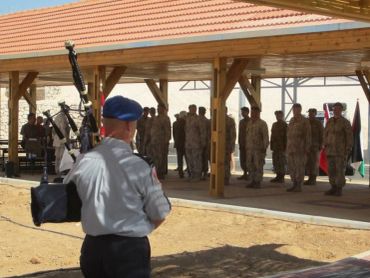
I wish to make special mention of Ken. As some of you know, my career in policing recently met its natural end. I was blessed with several professional development opportunities, but they took me away from Thunder Bay and the band, but always with pipes in hand. In the mid1990’s I spent two years as an instructor at the Ontario Police College, then another three in Ottawa at the Canadian Police College, making a sojourns to Africa and Australia, and then what I consider to be the pinnacle of my police duties I went to the middle east for a year as a Canadian Peacekeeper. On reflection, I was away - a lot.
There were tearful departures, however, each time I left for a new adventure, I knew that I had little to worry about. I knew that I could count on the passion and dedication of one man to ensure that the band and the yeoman’s duty to the police would continue, that my dream lived on. He said, “As long as there is breath in this body, it will endure”.
Pipe Major Ken Wilson is my friend, colleague and brother. He joined this band in 1987 and has been an intrinsic part of it since joining. His dedication to the Thunder Bay Police Pipe Band in our thirty year history, and I mean this with absolute sincerity, is without equal. He has served in every executive position that we have and has done so with grace, loyalty and without expectation of individual recognition. But that is about to change - well just the individual recognition part....
Presentation - Colonel in Chief
Pipe Major Wilson, it is with honour and great pleasure that I present you with this traditional pipe majors dirk. I thank you for your years of dedication and service to our band.
Please join me in congratulating Ken.
I’m going to stop waxing now, but before I do, I ask that you raise your glass and join with me in a toast. It’s in four parts and requires you to repeat what I say - here goes - Here’s to us, those like us, damned few, and they’re dead. Slainte
a photo gallery


This website uses cookies.
We use cookies to analyze website traffic and optimize your website experience. By accepting our use of cookies, your data will be aggregated with all other user data.